
Email engagement has never been more misunderstood — or more misused — than it is today.
Most marketers track engagement because dashboards make it easy. Opens, clicks, and activity charts are readily available, endlessly sortable, and deceptively comforting. But in 2026, not all engagement metrics matter equally, and some actively mislead senders into making decisions that harm deliverability.
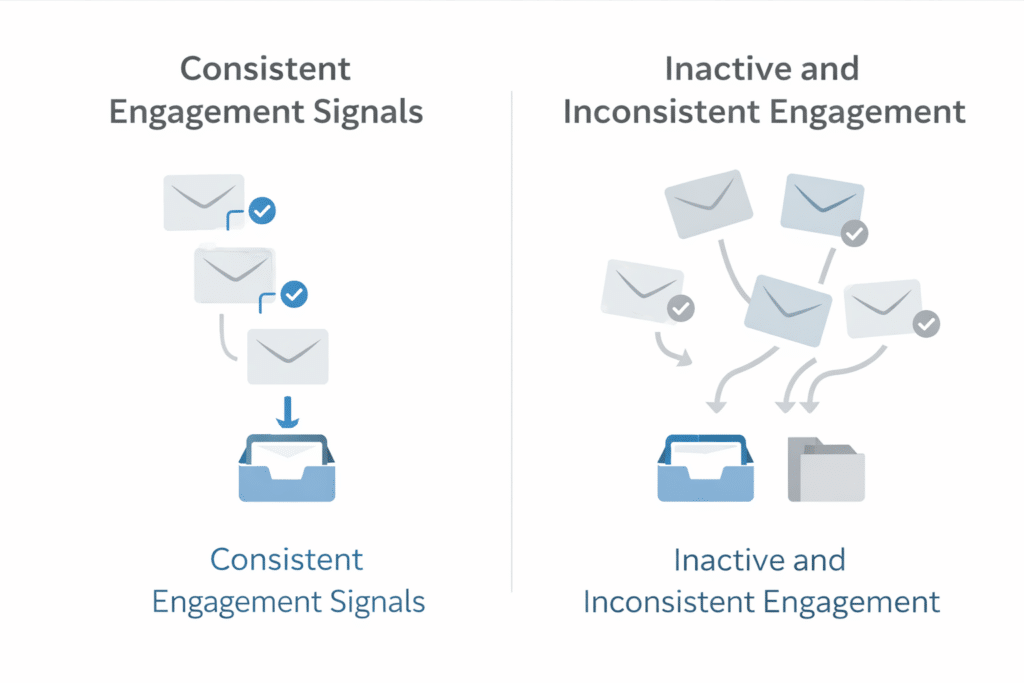
Mailbox providers do not evaluate engagement the way marketers do. They do not care about vanity metrics or isolated campaign performance. They care about patterns of behavior over time.
This article explains which engagement metrics actually influence deliverability, which ones do not, and why engagement quality — not volume — is the signal that matters most.
Engagement Is a Signal, Not a Score
The most important mistake marketers make is treating engagement like a scorecard.
High opens feel good. Click spikes look successful. But mailbox providers do not reward individual events — they evaluate consistent behavior patterns across entire audiences.
Engagement is not measured in moments. It is measured in trends.
A small, steady group of subscribers who consistently read, interact, and respond is more valuable than a large list that engages sporadically or not at all.
Opens Still Matter — But Not the Way You Think
Opens have become controversial, especially since privacy changes made them less precise. Some marketers dismiss them entirely. That is a mistake.
Opens still matter — directionally.
Mailbox providers can infer:
- Whether messages are being ignored
- Whether users regularly delete emails without reading
- Whether emails are opened and quickly closed
What matters is not how many opens you get on a campaign, but whether:
- The same users open repeatedly
- Engagement is stable over time
- Large portions of the list remain completely inactive
Opens are not a success metric. They are a health signal.
Clicks Indicate Intent, Not Trust
Clicks are often treated as the gold standard of engagement. They are not.
Clicks indicate intent, not inbox trust.
A user can click once and never engage again. A list can generate clicks while still producing negative signals elsewhere — especially if the majority of recipients never interact at all.
Mailbox providers weigh clicks in context:
- Are clicks consistent?
- Are they concentrated among a small subset?
- Do most recipients remain inactive?
Clicks matter most when they are distributed, not clustered.
Time-Based Engagement Is More Important Than Event-Based Metrics
One of the most overlooked engagement signals is time.
Mailbox providers pay attention to:
- How long messages remain unopened
- Whether emails are read or immediately deleted
- Whether engagement happens consistently across sends
Long-term inactivity is one of the strongest negative signals a sender can accumulate.
A subscriber who has not engaged in months contributes more harm than value — even if the address is valid and deliverable.
This is why engagement decay, not bounce rates, is often the root cause of deliverability decline.
Inactive Subscribers Are Not Neutral
Many marketers treat inactive subscribers as neutral. They are not.
Silence is interpreted as:
- Disinterest
- Irrelevance
- Or unwanted messaging
Mailbox providers do not wait for spam complaints to downgrade senders. They infer dissatisfaction through inaction.
The longer inactive subscribers remain on a list:
- The weaker engagement ratios become
- The stronger negative signals accumulate
- The harder inbox placement becomes to recover
This is why engagement metrics cannot be separated from list hygiene.
Engagement Quality Beats Engagement Volume
A campaign with:
- 10% consistent engagement
- Minimal deletions
- Stable reading behavior
Outperforms a campaign with:
- Higher peak activity
- Large inactive segments
- Erratic engagement patterns
Mailbox providers reward predictability and quality, not spikes.
Engagement volume fluctuates. Engagement quality compounds.
Why Engagement Metrics Must Be Evaluated Holistically
No single engagement metric tells the full story.
Mailbox providers evaluate engagement in combination with:
- List composition
- Sending consistency
- Subscriber tenure
- Historical behavior patterns
This is why optimizing for one metric often backfires.
For example:
- Aggressive subject lines may increase opens but increase deletions
- Over-segmentation may boost clicks but reduce overall engagement consistency
- Re-engagement blasts may produce short-term activity but long-term harm
Engagement metrics must be interpreted as part of a system, not in isolation.
Engagement Metrics Reflect List Quality
Ultimately, engagement metrics are not just performance indicators — they are diagnostics.
Poor engagement usually indicates:
- List acquisition problems
- Outdated subscriber data
- Misaligned expectations
- Or a failure to remove inactive users
Improving engagement does not start with creative changes. It starts with who you are emailing.
For a deeper explanation of how list quality ultimately determines inbox placement, see our core guide that explains how email list cleaning improves deliverability.
This is why engagement metrics and deliverability cannot be separated from list cleaning practices.
The Engagement Metrics That Matter Most in 2026
In practical terms, the engagement signals that matter most are:
- Consistent opens across multiple campaigns
- Stable engagement ratios over time
- Low long-term inactivity rates
- Minimal deletion-without-reading behavior
- Clear disengagement boundaries (removal when engagement stops)
These signals tell mailbox providers that your emails are:
- Expected
- Relevant
- And welcomed by recipients
Everything else is secondary.
Engagement Is Evidence of Respect
Mailbox providers reward senders who respect subscribers.
Respect is demonstrated through:
- Sending only to people who engage
- Reducing volume when engagement declines
- Removing subscribers who no longer respond
- Maintaining predictable sending behavior
Engagement metrics are simply the evidence of that respect.
When engagement quality improves, sender reputation improves.
When sender reputation improves, deliverability improves.
That relationship is consistent — even as metrics and tools evolve.