
Email list cleaning is often discussed as a best practice, but rarely explained in terms of outcomes. Marketers are told to clean their lists, remove bad addresses, and move on — without understanding what actually changes once a list is cleaned, how inbox placement improves, or why deliverability stabilizes afterward.
This article explains what concretely happens after you clean an email list, how inbox providers interpret those changes, and why list cleaning is one of the few actions that can reset negative deliverability trends without changing content, cadence, or tools.
If you are looking for a step-by-step explanation of how email list cleaning works, start with this foundational guide: Email List Cleaning & Hygiene: Removing Junk Before You Send.
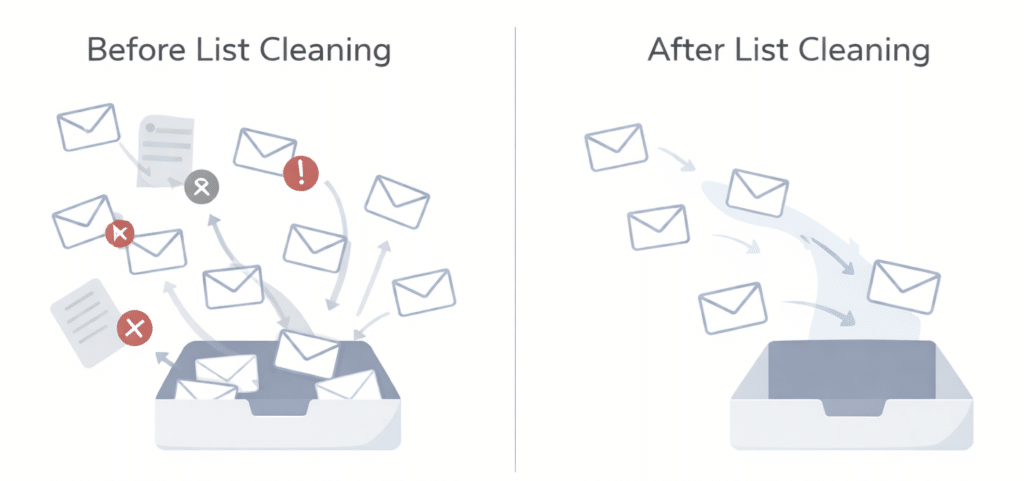
What follows is the after picture — the measurable shifts that occur once a list is properly cleaned.
Deliverability Is Not a Single Metric
Before discussing outcomes, it is important to clarify what “deliverability” actually means.
Deliverability is not the same as:
- Delivery (accepted by the receiving server)
- Open rates
- Click rates
Deliverability refers to where messages land after acceptance:
- Inbox
- Promotions tab
- Spam folder
- Silent filtering (delivered but never surfaced)
Inbox providers make that decision based on sender behavior over time, not individual campaigns. Email list cleaning directly influences the signals that feed those decisions.
What Changes Immediately After a List Is Cleaned
1. Hard Bounces Drop to Near Zero
The most immediate and visible change is a reduction in hard bounces.
Hard bounces signal:
- Invalid domains
- Nonexistent mailboxes
- Typos
- Deactivated accounts
A clean list removes these addresses before sending, which means inbox providers stop seeing repeated delivery failures tied to your domain or IP.
This alone reduces one of the strongest negative reputation signals used by Gmail, Outlook, Yahoo, and corporate mail servers.
2. Complaint and Spam Trap Risk Declines
Many spam complaints do not come from engaged users — they come from:
- Abandoned inboxes
- Recycled addresses
- Old corporate accounts
- Honeypot spam traps
Cleaning removes addresses that no longer belong to active humans. That reduces the likelihood of:
- “This is spam” clicks
- Hidden spam trap engagement
- Silent filtering escalation
This is especially important because complaint signals are weighted far more heavily than opens or clicks.
3. Engagement Signals Normalize
After cleaning, engagement rates often improve without changing content.
Why:
- Dead addresses no longer suppress averages
- Inactive recipients are removed
- Engagement ratios reflect real humans again
Inbox providers look at:
- Opens relative to list size
- Click behavior over time
- Deletion without reading
- Ignoring patterns
Cleaning improves those ratios by removing addresses that never engage, allowing your true audience behavior to surface.
What Changes Over the Following 2–6 Weeks
Deliverability improvement is not instantaneous. Inbox providers operate on rolling reputation windows.
Inbox providers evaluate list hygiene as part of a broader trust model that includes domain history, complaint patterns, and sender reputation, which is explained in detail in this article on email sender and IP reputation.
After consistent sending to a cleaned list, the following shifts typically occur.
4. Sender Reputation Stabilizes
Sender reputation is not a score you control — it is an inferred trust profile.
Cleaning stabilizes reputation because:
- Error rates remain consistently low
- Complaint volatility disappears
- Engagement patterns become predictable
This is particularly important for domains that have experienced sudden inbox placement drops, spam folder migration, Gmail tab misclassification, or corporate filtering blocks.
List cleaning gives providers a clean behavioral dataset to reassess your sender profile.
5. Inbox Placement Improves Without Content Changes
One of the most misunderstood aspects of deliverability is that content is rarely the root cause.
Once a list is clean:
- Inbox placement improves even with identical copy
- Promotions versus spam placement often shifts upward
- Corporate gateways reduce filtering aggressiveness
This happens because inbox providers trust senders that demonstrate control over their data hygiene.
6. Re-Engagement Campaigns Become Viable Again
Dirty lists make re-engagement campaigns dangerous. Clean lists make them effective.
After cleaning:
- Re-engagement emails reach real inboxes
- Opens and clicks are accurately measured
- Suppression logic works correctly
This allows marketers to segment intelligently instead of sending indiscriminately.
Why Validation Alone Does Not Produce These Results
Many marketers confuse email validation with email list cleaning.
Validation checks whether an address exists at the moment of testing. Cleaning evaluates:
- Historical engagement
- Behavioral decay
- Risk indicators
- Lifecycle context
Validation alone does not remove spam traps, disengaged recipients, complainers, or dormant but technically valid inboxes.
This distinction is covered in detail here: Why Email Validation Does Not Guarantee Deliverability
Deliverability improves when risk is reduced, not when syntax is confirmed.
The Long-Term Compounding Effect of List Cleaning
List cleaning is not a one-time fix. Its real value is cumulative.
Over time, cleaned lists:
- Require fewer warm-up cycles
- Recover faster from deliverability dips
- Scale more predictably
- Support higher sending frequency without penalty
Inbox providers reward consistency more than perfection. Cleaning makes consistency possible.
How Often Lists Should Be Cleaned
There is no universal interval, but most high-performing senders follow a cadence based on volume, acquisition velocity, industry churn, and engagement decay.
General guidance:
- High-volume senders: quarterly
- Moderate senders: biannually
- Event-driven lists: before major sends
The goal is not to shrink lists — it is to maintain signal clarity.
FAQ: Email List Cleaning & Deliverability
Does email list cleaning guarantee inbox placement?
No. It removes the most common negative signals, but inbox placement still depends on consistency, engagement, and sending behavior.
How long does it take to see deliverability improvement?
Most senders see measurable improvement within two to six weeks of consistent sending to a cleaned list.
Will cleaning reduce my list size too much?
Short-term volume may drop, but long-term inbox placement and revenue typically improve. Inflated lists do not outperform healthy ones.
Should I clean before or after a re-engagement campaign?
Before. Re-engagement campaigns sent to dirty lists amplify risk.
Is list cleaning only for large senders?
No. Smaller senders often benefit more because reputation volatility affects them faster.
If you want to apply these principles in practice, Purelist is designed specifically for email list cleaning and hygiene — helping remove invalid, inactive, and high-risk addresses so deliverability signals can stabilize before you send.
Final Takeaway
Email list cleaning does not improve deliverability by magic. It improves deliverability by changing the data inbox providers use to judge you.
Once invalid, inactive, and risky addresses are removed:
- Reputation stabilizes
- Engagement becomes meaningful
- Inbox placement improves without creative changes
For senders struggling with inconsistent results, cleaning is often the fastest way to reset trust — not by doing more, but by sending to fewer, better recipients.